All states · Unofficial practice
Hunter education practice test
Every state requires hunter education for at least some new hunters, usually based on age or birth year. State courses follow the same national standards: safe handling in the field, tree stands, zones of fire, shot placement, ethics, survival and conservation.
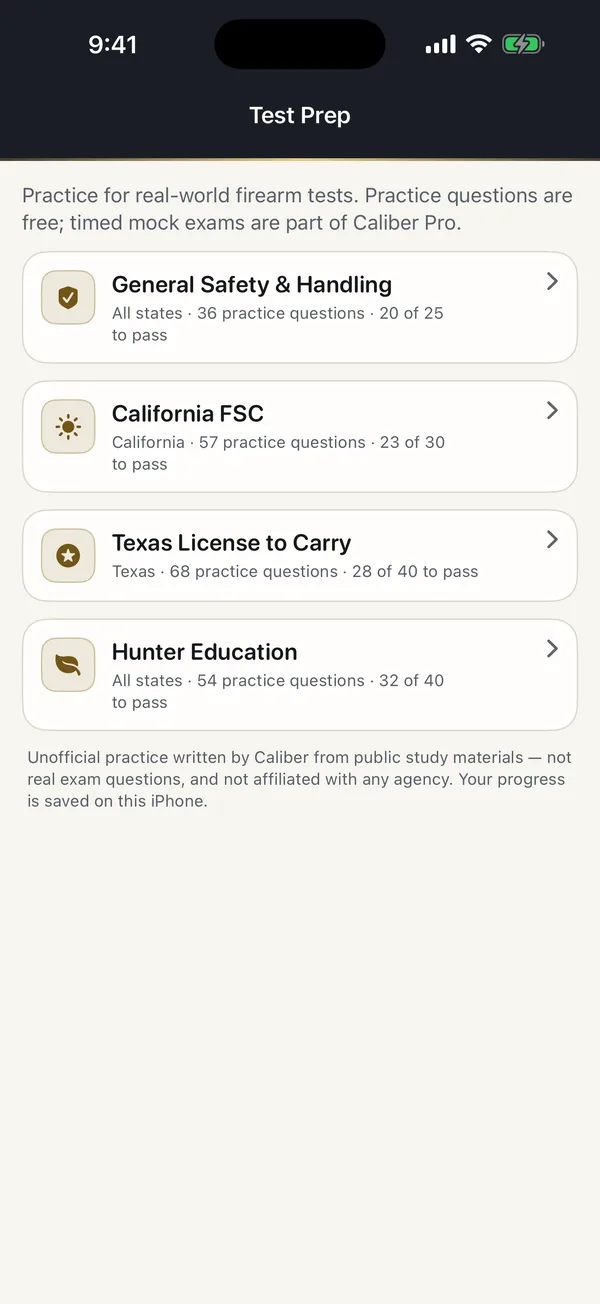
- 54
- practice questions in Caliber
- 8
- topics
- 32/40
- to pass Caliber's mock exam
- 40 min
- mock exam time limit
Try 5 sample questions
Pick your answer, then tap “Show answer”. The full set of 54 is in the app.
Question 1
Which carry gives the best control of the muzzle, especially in thick brush?
- AThe shoulder carry, barrel back
- BThe two-handed (ready) carry
- CThe trail carry, held in one hand
- DThe sling carry over one shoulder
Show answerAnswer
B. The two-handed (ready) carry
Both hands on the firearm, muzzle up and finger outside the guard — the best muzzle control in brush.
Source: TPWD Hunter Education online course · Safely Carrying Firearms
Question 2
In TPWD's analysis of hunting incidents, what was the leading cause?
- AFalls from elevated stands
- BVictims mistaken for game
- CSwinging outside the zone of fire
- DStumbling and dropping a firearm
Show answerAnswer
A. Falls from elevated stands
Falls from stands — often without a harness or haul line — topped the list, ahead of careless muzzle control.
Source: TPWD, Top Ten Hunter Education Lists
Question 3
For a hunter facing 12 o'clock, a standard safe zone of fire runs from…
- A11 o'clock to 1 o'clock
- B8 o'clock to 4 o'clock
- C10 o'clock to 2 o'clock
- D9 o'clock to 3 o'clock
Show answerAnswer
C. 10 o'clock to 2 o'clock
A standard zone is 10 to 2 — and each hunter's zone is agreed before the hunt.
Source: TPWD Hunter Education online course · Firearm Safety
Question 4
Which shot angle gives the largest target for the heart and lungs?
- ARear-end
- BBroadside
- CQuartering toward
- DHead-on
Show answerAnswer
B. Broadside
Broadside presents the largest vital area — the best shot for a new hunter.
Source: TPWD Hunter Education online course · Shots to the Vital Areas
Question 5
What should you do before every hunt?
- APack extra ammunition
- BLeave a written hunt plan with someone
- CPost your location on social media
- DTell no one, to keep your spot secret
Show answerAnswer
B. Leave a written hunt plan with someone
Who's going, where, when you'll be back, and contacts — left with a responsible adult. "Plan your hunt, then hunt your plan."
Source: TPWD Hunter Education online course · Preparation and Survival
Keep going in Caliber
49 more questions, practice by topic, and timed mock exams with Caliber Pro.
Topics covered
- Handling in the field7 questions
- Tree stands & incidents6 questions
- Zones of fire & target ID7 questions
- Shot placement7 questions
- After the shot & care of game7 questions
- Ethics6 questions
- Preparation & survival8 questions
- Conservation6 questions
Study from the source
Caliber's questions are written from Texas Parks and Wildlife Department's public online hunter education course and "Top Ten Hunter Education Lists", and the Congressional Research Service report on the Pittman-Robertson Act. Read it before your test; it's what the real questions come from.
Open the official study material ↗Unofficial practice — not affiliated with any state wildlife agency or hunter education association. Caliber wrote these questions from public government course material; your state's exam and its laws differ.
Hunter Education practice FAQ
What is the Hunter Education test?
Every state requires hunter education for at least some new hunters, usually based on age or birth year. State courses follow the same national standards: safe handling in the field, tree stands, zones of fire, shot placement, ethics, survival and conservation.
Are these the real test questions?
Unofficial practice — not affiliated with any state wildlife agency or hunter education association. Caliber wrote these questions from public government course material; your state's exam and its laws differ.
How many practice questions does Caliber have for the Hunter Education?
54, across 8 topics: handling in the field, tree stands & incidents, zones of fire & target id, shot placement, after the shot & care of game, ethics, preparation & survival, conservation. Practice sets of 10 are free. Timed mock exams (40 questions, 32 to pass, 40 minutes) come with Caliber Pro.
What should I study?
The official study material: Texas Parks and Wildlife Department's public online hunter education course and "Top Ten Hunter Education Lists", and the Congressional Research Service report on the Pittman-Robertson Act. Caliber's questions are written from it, and every answer explains which part it comes from.
Practice for the Hunter Education on your iPhone
54 unofficial practice questions with explanations, free. Timed mock exams with Caliber Pro.
Free download · Optional Caliber Pro upgrade · iPhone and iPad
Other practice tests
More in Caliber
Public hunting land
Public hunting land in all 50 states, with each state's license fees and official links.
Learn more →
Firearm safety course
177 bite-size lessons with quizzes, from the four safety rules to safe storage.
Learn more →
Ballistic calculator & shooting tools
Free bullet drop calculator, DOPE book, scope clicks, distance estimating and more.
Learn more →
CaliberBecome a safer, more skilled firearm owner. Free on iPhone and iPad.
Download on the App StoreFeatures
Guides & directories
- The four firearm safety rules
- California FSC practice test
- Texas LTC practice test
- Hunter education practice test
- Shooting range directory
- Public hunting land in Colorado
- Public hunting land in Florida
- Public hunting land in Georgia
- Public hunting land in Michigan
- Public hunting land in Minnesota
- Public hunting land in Pennsylvania
- Public hunting land in Texas
- Public hunting land in Wisconsin
Caliber is an educational and tracking tool for lawful, responsible ownership. It is not legal advice and not a substitute for in-person instruction. Caliber doesn't sell firearms, ammunition or accessories. Always follow the four safety rules and your local laws. Caliber is made by Norbrook Media LLC. Apple, the Apple logo, iPhone and iPad are trademarks of Apple Inc. App Store is a service mark of Apple Inc.