Firearm safety basics
The four rules of gun safety, explained
Nearly every firearm accident involves breaking at least one of four universal safety rules. They overlap on purpose: follow all four and a single mistake can't become a tragedy. The goal isn't to memorize them. It's to make them automatic.
- 1.Treat every firearm as if it's loaded
- 2.Never point the muzzle at anything you aren't willing to destroy
- 3.Keep your finger off the trigger until your sights are on target
- 4.Know your target and what's beyond it
Rule 1
Treat every firearm as if it's loaded
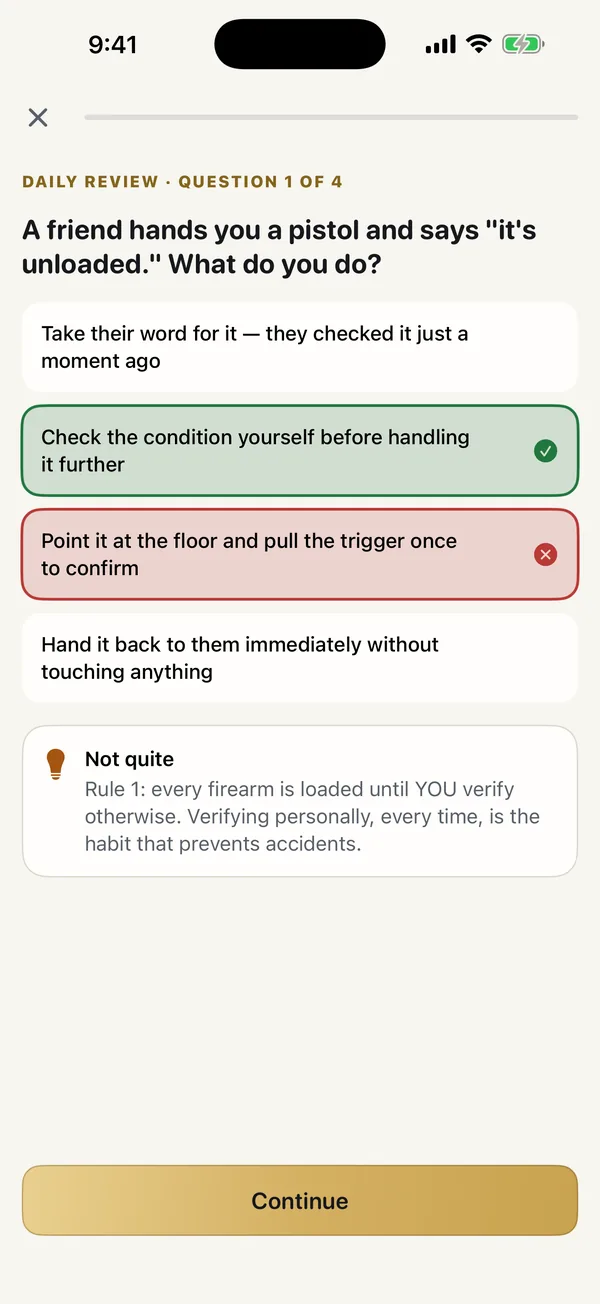
“I didn't know it was loaded” shows up in accident reports again and again. The fix is a habit: there's no such thing as an unloaded gun in how you handle one. Even after you've checked it yourself, keep treating it with the same respect.
- Check the condition yourself every time you pick one up
- A firearm someone hands you is loaded until you've checked it
- Don't let what you think you know change how you handle it
Rule 2
Never point the muzzle at anything you aren't willing to destroy
Muzzle discipline is the most visible safety habit. Know where the muzzle points at all times: while carrying, setting a firearm down, cleaning it, or showing it to someone. A safe direction is one where an unintended discharge would hurt no one.
- A safe direction depends on where you are, so think about walls and floors
- Watch the muzzle during transitions: casing, uncasing and handing over
- If someone's muzzle sweeps you, say so. Experienced shooters respect it
Rule 3
Keep your finger off the trigger until your sights are on target
Rest your trigger finger straight along the frame (“indexed”) until your sights are on the target and you've decided to fire. Under stress, hands clench; an indexed finger can't finish a press you never decided to make.
- Index your finger along the frame by default
- Finger on the trigger only when your sights are on target and you've decided to fire
- Holstering, moving or clearing a malfunction? Finger off
Rule 4
Know your target and what's beyond it
Bullets can pass through a target and keep going. Before you fire, positively identify your target and know what's behind and around it. At the range, that means a proper backstop. Everywhere else, it means never firing at a shape, a sound or a shadow.
- Positively identify your target; never assume
- Know your backstop and what's beyond it
- If you're not sure, don't shoot
More habits of a safe shooter
The four rules are the core. Safety classes and range rules usually add these:
- Store firearms securely
- Locked and out of reach of children and anyone who shouldn't have access, with ammunition stored separately where practical. Check your state's storage laws.
- Protect your eyes and ears
- Wear eye and ear protection every time you shoot, including outdoors and for spectators.
- Use the right ammunition
- Match the cartridge to what's stamped on the barrel or slide. The wrong ammunition can destroy a firearm and injure you.
- Never mix firearms with alcohol or drugs
- Don't handle a firearm while impaired, or when you're angry or upset.
- Know how your firearm works
- Learn how to load, unload, check and clear your specific firearm before you shoot it.
- Follow the range's rules and commands
- When a range officer calls “Cease fire,” stop, take your finger off the trigger and wait for instructions.
Make the rules a habit with Caliber
Caliber's free safety course starts with these four rules, then builds on them across 177 bite-size lessons with quizzes and a daily review of anything you missed.